
Blog
The Truth About Blue Light and Its Impact on Our Sleep
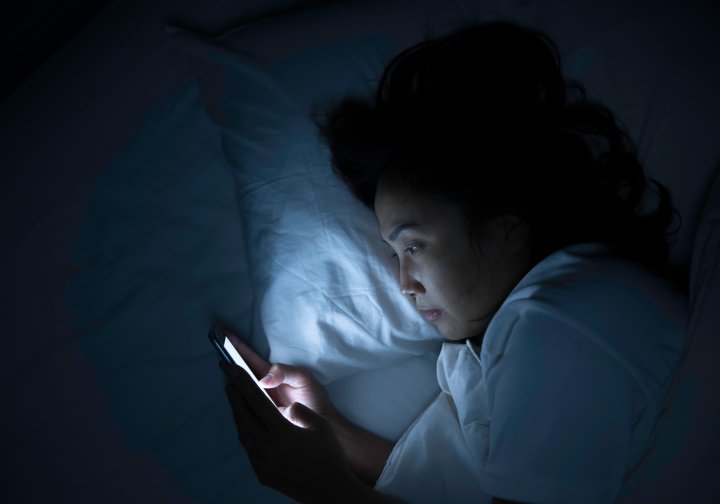
For many of us, it has become an automatic ritual: in the evening, when we finally lie down in bed after a long day, we reach for our phones. We see scrolling through social media, reading the news, or watching videos as a well-deserved form of relaxation, a way to "switch off." Yet, we wake up in the morning feeling exhausted, as if we hadn't slept at all. The problem lies right in the screens of our devices, specifically in the spectrum of blue light they emit. While we are trying to ease into a state of rest, blue light acts on our nervous system like high noon, keeping us stuck in a state of alertness even just before sleep.
This profound disconnect between physical fatigue and the alertness felt by our brain fundamentally affects sleep quality and, in the long run, the stability of our mental balance. In this article, we will take a closer look at what happens in our bodies when we expose ourselves to digital radiation in the evening. We will explore why blue light suppresses the production of a key sleep hormone, how it disrupts the natural structure of our rest, and why this seemingly innocent habit might be the hidden cause of morning anxiety or permanent exhaustion.
How Blue Light Deceives Our Brain
To understand how evening scrolling can affect us so profoundly, we must look at how our brain perceives light. The key is the so-called retinohypothalamic tract, a neural pathway that carries light information directly from the retina to the brain. Its task, put simply, is to inform the organism whether it is day or night. Once the signal reaches the brain, it activates the suprachiasmatic nucleus (SCN) located in the hypothalamus. The SCN functions as our body’s master clock, a pacemaker, synchronizing our internal circadian rhythms with the external environment.
The transmission of information from the retinohypothalamic tract to the SCN is handled by specialized photosensitive ganglion cells. These cells are most sensitive to light with a wavelength of 460–480 nm, which is precisely the blue light to which our internal clocks are most attuned. The problem is that the brain cannot distinguish between screen radiation and intense midday sun, and as a result, it signals the entire body that it is not yet time for sleep.
This phenomenon has a direct impact on our hormonal system, specifically on the pineal gland, a small gland in the brain responsible for producing melatonin. Melatonin, often dubbed the "sleep hormone," regulates circadian rhythms. Its secretion changes throughout the day: increasing at dusk, peaking around midnight, and decreasing again in the morning. This means that in the dark, melatonin levels are high, whereas when it is light, they remain low. The difference between the maximum and minimum is more than tenfold.
However, as soon as the brain registers blue light in the late evening, it sends an immediate command to the pineal gland to stop melatonin production, which is crucial for falling asleep easily. Even brief exposure to intense blue light before bedtime can delay the release of melatonin by up to 90 minutes.
This neurobiological paradox has serious consequences not only for sleep quality but also for our psychological well-being. Without sufficient melatonin release, the resulting circadian rhythm disruption becomes a trigger for morning anxiety, decreased concentration, and, in the long term, a significant risk factor for depression.
The Psychological Impact of Blue Light
Unfortunately, the disruption of the circadian rhythm by blue light does not end with us falling asleep later. It fundamentally alters what is known as "sleep architecture." When the brain struggles to fall asleep due to a lack of melatonin, the REM phase, a stage characterized by high brain activity, rapid eye movements, and vivid dreaming, is often suppressed. It is during this phase that the brain processes emotions, stores memories, and regulates mood.
This lack of quality REM sleep triggers a cascade of further issues. Research data indicates that repeated circadian desynchronization caused by evening blue light exposure contributes to increased emotional instability and higher stress reactivity. The timing of light exposure is a key factor: while daylight supports alertness, evening light disrupts the biological processes essential for quality sleep (Blazhkova et al., 2025). A statistically significant correlation has also been found between poor sleep quality and higher rates of depressive and anxiety symptoms (Lyall et al., 2018).
Without this nightly "emotional reset," levels of the stress hormone cortisol rise even before waking up, which leads to morning anxiety or a feeling of being overwhelmed. Regular evening scrolling on a mobile phone increases these symptoms by up to 30%, as the brain lacks the time needed to process the day’s psychological load. For example, a team of Japanese researchers published a study in 2021 showing that limiting blue light before bed improved the cognitive performance of participants after just one week (Ishizawa et al., 2021).
This seemingly innocent habit is therefore not just a sleep problem, but it is becoming a silent risk to our mental health. Every hour spent in front of blue light in the evening effectively robs us of deep regeneration and the ability to cope with stress effectively.
Finding the Way Out
The good news is that our internal clocks are plastic, and they respond relatively quickly to changes in our habits. You don’t have to give up technology entirely, you simply need to start being mindful of how you use it in the evening. A simple "digital curfew" can be the first step toward recovery.
-
The 3-2-1 Rule: Ideally, finish your last heavy meal 3 hours before bed, conclude all work tasks 2 hours before bed, and put away your phone and computer 1 hour before bed.
-
Red Filters and "Night Shift": If you must work on your phone, use applications that block blue light. Shifting the display to orange or red tones is much easier on both the eyes and the brain.
-
Morning Light for a Rhythm Reset: Expose yourself to daylight as soon as you wake up. A short walk or even just sitting by a window signals the start of the day to your brain. This suppresses any remaining melatonin, triggers alertness, and makes it easier to fall asleep later that evening.
Understanding how blue light affects us is the key to regaining control over both our sleep and our mood. You are tending to your mental health the moment you decide to put down your phone in the evening, giving your brain the space it needs for an essential nightly reset.
About the Author: Jana FelklováJana is a second-year master’s student in the Theoretical and Research Psychology program at Charles University in Prague. She viewed her work at Unicare Medical Center as a valuable opportunity to gain hands-on experience in the field of psychology while pursuing her studies. |
References:
Blazhkova, A., Czaja, M., Rehan, D., Rzym, K., Sitka, H., Solisch, S., Susłow, A., & Szczęsna, E. (2025). Blue light from screen and depression – A review. Polish Journal of Public Health, 135, 49–56. https://doi.org/10.12923/2083-4829/2025-0010
Lyall, L. M. et al. (2018) Association of disrupted circadian rhythmicity with mood disorders, subjective wellbeing, and cognitive function: a crosssectional study of 91 105 participants from the UK Biobank. Lancet Psychiatry, 5(6), pp. 507–514. doi:10.1016/S2215-0366(18)30139-1
Ishizawa, M., Uchiumi, T., Takahata, M., Yamaki, M., & Sato, T. (2021). Effects of pre-bedtime blue-light exposure on ratio of deep sleep in healthy young men. Sleep Medicine, 84, 303–307.